BSE Prices delayed by 5 minutes ! Prices as on   Dec 15, 2025 - 3:59PM   ABB India 5276.1 [ 0.03% ]ACC 1780 [ 0.47% ]Ambuja Cements 554 [ 1.09% ]Asian Paints Ltd. 2780.2 [ 0.53% ]Axis Bank Ltd. 1284.95 [ -0.10% ]Bajaj Auto 8915.3 [ -1.10% ]Bank of Baroda 285.05 [ 0.19% ]Bharti Airtel 2071.95 [ -0.55% ]Bharat Heavy Ele 282.55 [ -1.00% ]Bharat Petroleum 366.75 [ 0.53% ]Britannia Ind. 6037.5 [ 2.07% ]Cipla 1507.25 [ -0.66% ]Coal India 384.45 [ 0.30% ]Colgate Palm 2165.9 [ 0.27% ]Dabur India 497.25 [ 0.53% ]DLF Ltd. 697 [ -0.35% ]Dr. Reddy's Labs 1277.4 [ -0.18% ]GAIL (India) 169.85 [ -0.56% ]Grasim Inds. 2820.8 [ -0.57% ]HCL Technologies 1683.8 [ 0.68% ]HDFC Bank 994.6 [ -0.56% ]Hero MotoCorp 5953 [ -0.10% ]Hindustan Unilever L 2292 [ 1.37% ]Hindalco Indus. 847.7 [ -0.54% ]ICICI Bank 1365.2 [ -0.06% ]Indian Hotels Co 729.3 [ -0.75% ]IndusInd Bank 851.3 [ 0.66% ]Infosys L 1607.05 [ 0.52% ]ITC Ltd. 402.3 [ 0.45% ]Jindal Steel 1030 [ 0.04% ]Kotak Mahindra Bank 2180.5 [ 0.19% ]L&T 4090.95 [ 0.42% ]Lupin Ltd. 2086.15 [ -1.32% ]Mahi. & Mahi 3607.55 [ -1.94% ]Maruti Suzuki India 16374.25 [ -0.89% ]MTNL 36.14 [ -1.90% ]Nestle India 1241.75 [ 0.29% ]NIIT Ltd. 90.33 [ 2.38% ]NMDC Ltd. 78.46 [ 0.71% ]NTPC 323.85 [ -0.37% ]ONGC 235.35 [ -1.13% ]Punj. NationlBak 118.7 [ 0.76% ]Power Grid Corpo 262.3 [ -0.49% ]Reliance Inds. 1556.05 [ 0.00% ]SBI 967.15 [ 0.44% ]Vedanta 550 [ 1.19% ]Shipping Corpn. 222.15 [ -1.46% ]Sun Pharma. 1794.2 [ -0.01% ]Tata Chemicals 765.75 [ 0.90% ]Tata Consumer Produc 1153.95 [ 0.40% ]Tata Motors Passenge 347.1 [ -0.10% ]Tata Steel 172.8 [ 0.52% ]Tata Power Co. 381.6 [ -0.08% ]Tata Consultancy 3230.4 [ 0.32% ]Tech Mahindra 1576.7 [ -0.15% ]UltraTech Cement 11695.2 [ -0.25% ]United Spirits 1441.4 [ -0.39% ]Wipro 261.7 [ 0.44% ]Zee Entertainment En 93.75 [ -0.53% ]
BSE

MARKETS

Mutual Fund

MUTUAL FUND CONCEPT

1. CONCEPT 

2. ORGANISATION OF A MUTUAL FUND 

3. ADVANTAGES OF MUTUAL FUNDS 

4. TYPES OF MUTUAL FUND SCHEMES 

5. FREQUENTLY USED TERMS 


CONCEPT 

A Mutual Fund is a trust that pools the savings of a number of investors who share a common financial goal. The money thus collected is then invested in capital market instruments such as shares, debentures and other securities. The income earned through these investments and the capital appreciation realised are shared by its unit holders in proportion to the number of units owned by them. Thus a Mutual Fund is the most suitable investment for the common man as it offers an opportunity to invest in a diversified, professionally managed basket of securities at a relatively low cost. The flow chart below describes broadly the working of a mutual fund:
Mutual Fund Operation Flow Chart
 
Top 
 
ORGANISATION OF A MUTUAL FUND 

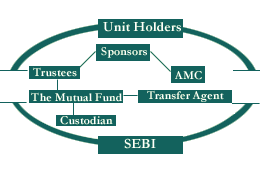
There are many entities involved and the diagram below illustrates the organisational set up of a mutual fund:
Organisation of a Mutual Fund
 
Top 
 
ADVANTAGES OF MUTUAL FUNDS 

The advantages of investing in a Mutual Fund are:
  • Professional Management
  • Diversification
  • Convenient Administration
  • Return Potential
  • Low Costs
  • Liquidity
  • Transparency
  • Flexibility
  • Choice of schemes
  • Tax benefits
  • Well regulated
  •  
    Top 
     
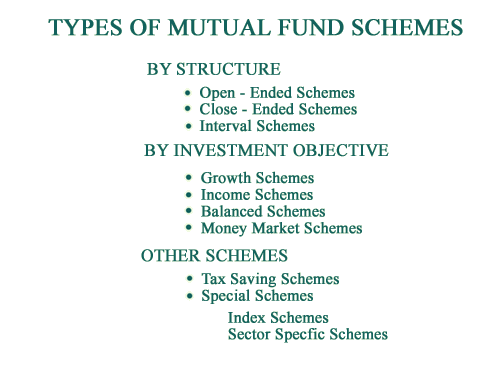
    TYPES OF MUTUAL FUND SCHEMES 

    Wide variety of Mutual Fund Schemes exist to cater to the needs such as financial position, risk tolerance and return expectations etc. The table below gives an overview into the existing types of schemes in the Industry.
    Top 
     
    FREQUENTLY USED TERMS 
     
    Net Asset Value (NAV)

    Net Asset Value is the market value of the assets of the scheme minus its liabilities. The per unit NAV is the net asset value of the scheme divided by the number of units outstanding on the Valuation Date.
     
    Sale Price

    Is the price you pay when you invest in a scheme. Also called Offer Price. It may include a sales load.
     
    Repurchase Price
    Is the price at which a close-ended scheme repurchases its units and it may include a back-end load. This is also called Bid Price.
     
    Redemption Price
    Is the price at which open-ended schemes repurchase their units and close-ended schemes redeem their units on maturity. Such prices are NAV related.
     
    Sales Load
    Is a charge collected by a scheme when it sells the units. Also called, ‘Front-end’ load. Schemes that do not charge a load are called ‘No Load’ schemes.
     
    Repurchase or ‘Back-end’Load
    Is a charge collected by a scheme when it buys back the units from the unitholders.
     
    Top